How to Save Your Job and Business - with AI

The challenges (in brief)
- Entry-level squeeze: graduate openings are down in line with wider hiring falls, and many of the first-rung tasks are exactly the ones AI can do fastest. Rishi Sunak: How to save your j… Rishi Sunak: How to save your j…
- Early-career exposure: 22–25-year-olds in AI-exposed roles (e.g., software, customer service) are already seeing employment declines. Rishi Sunak: How to save your j…
- “Flat is the new up”: CEOs believe they can grow without adding headcount, amplifying competition for starts. Rishi Sunak: How to save your j…
Balancing truths
- Human skills matter more, not less: demand for interpersonal and relationship-building skills has increased.
- New work emerges: from AI engineers to data-centre trades like welders and electricians.
Entry-level work used to be the rehearsal room: first drafts, research, basic analysis, minutes, follow-ups. That’s where young people learnt tempo—how fast to move, how careful to be—and the human bits that don’t show on a CV: listening well, asking cleaner questions, landing a clear update.
AI has snapped up much of that rehearsal space. It writes tidy summaries at speed, drafts emails that are “good enough,” and chews through data without needing a coffee. At the same time, leaders are eyeing productivity gains without adding headcount. Cue a squeeze at the start line.
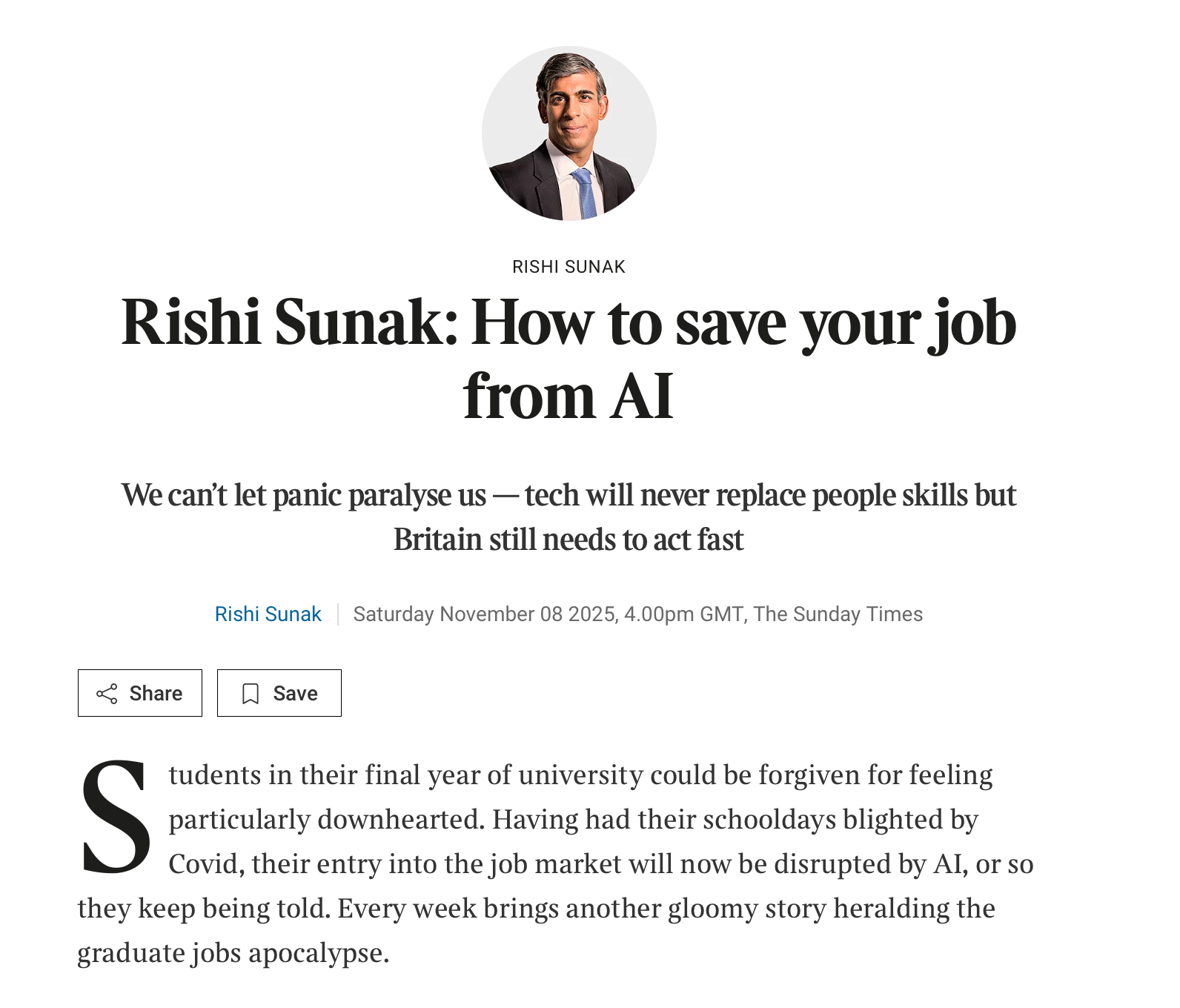
But there’s another picture forming beside it. Businesses still need judgment, context, and trust. Customers still buy from people who understand their world and can explain options plainly. New roles and routes are appearing too—jobs that blend domain know-how with AI tools, and practical opportunities created by AI’s build-out (from data infrastructure to customer operations). In short: the grind is changing shape, not disappearing. The question is how we help young people—and their managers—build the right muscles quickly, without the old scaffolding.
The practical answer looks refreshingly simple. Get hands-on with AI daily, not as an abstract subject but as a working partner: set the brief, define expectations, check the output, tighten the loop. Pair that with deliberate interpersonal practice: shorter, clearer meetings; notes that reduce confusion; updates that hold the line on expectations. None of this needs permission. All of it builds momentum and credibility in uncertain times.
Three truths to hold at once
- AI compresses the routine. The busywork goes first. Treat that as a gift: use the time you win back to learn the market, talk to customers, and improve decisions.
- Interpersonal skills compound. Clear questions, tidy handovers, and steady follow-ups shorten sales cycles and build trust. These are now your unfair advantage.
- Integration beats imitation. Don’t try to write like a model; learn to use models to deliver outcomes your clients actually value.
If this resonates, here’s a simple next step.
Who’d be interested in getting together—entrepreneurs, managers, and early-career professionals—to practise two high-leverage skill sets side by side: AI fluency and interpersonal skills, with a view to improving sales?
I’m sounding out interest in a short, practical session where we:
- swap real prompts and QA steps that save time in sales and delivery,
- rehearse a discovery call and a difficult update (the two conversations that make or break revenue),
- leave with a one-page action plan you can run the very next day.
If you’d like to be part of that, say the word and I’ll organise the first one when I get back from Spain at the end November.
And if you’d prefer it inside your company or local network, we can arrange that too. The first rung may have shifted, but we can build a sturdier one—together.
Comment or message me.
Member discussion