Working Harder will Not Make You Wealthy
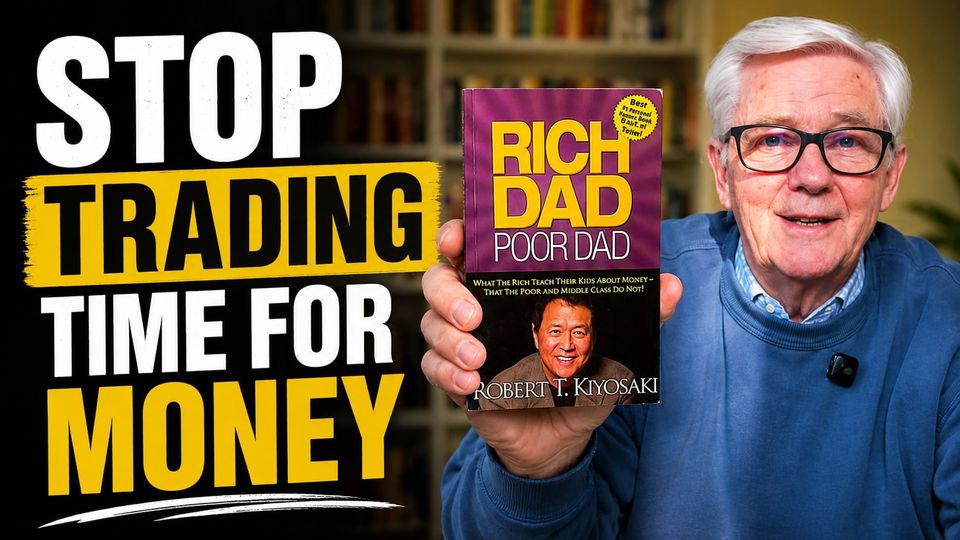
When I first read Robert Kiyosaki’s Rich Dad Poor Dad, one idea caught my attention more than anything else.
It wasn’t simply about making more money. It was about how you make money.
That sounds like a small distinction, but it changes the way you think about work, business and ultimately financial freedom.
Most of us are brought up with a fairly straightforward idea of how life works. Get a good education, find a decent job, work hard, earn a good salary, buy a house and eventually retire. There is nothing particularly wrong with that path. It has worked reasonably well for millions of people.
But it does create an assumption that is rarely questioned: that the way to become financially better off is to become better at earning an income.
Kiyosaki challenged that assumption.
Don’t just ask how much you earn. Ask where the income comes from.
This is where I think the idea behind Kiyosaki’s Cash Flow Quadrant becomes interesting.
There are different ways of generating an income. You can work for an employer. You can work for yourself. You can build a business that operates through people and systems. Or you can invest in assets that generate income or grow in value.
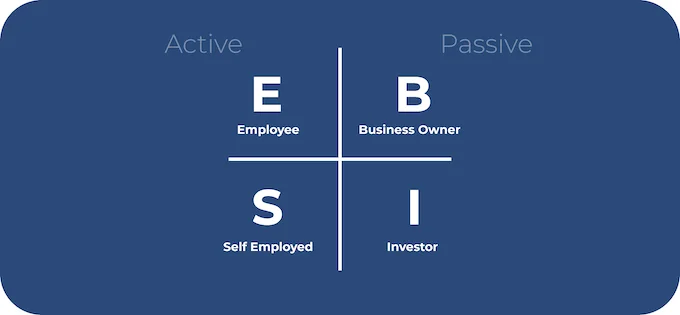
The important distinction isn’t that one is automatically good and another automatically bad. It is the degree to which your income depends upon your personal time and effort.
That is a much more useful way of looking at it.
I have come across plenty of people who have left employment because they wanted more freedom, only to discover that their new business has created a different kind of dependency. They now have more control over their working life, but they also have more responsibility.
They can’t take a holiday without thinking about the clients, and they can’t take a day off without wondering what will happen to the business. If they stop working for any meaningful period of time, the income stops.
They may be self-employed, but they haven’t necessarily created financial independence.
Being self-employed isn’t the same as being free.
This is one of the traps of entrepreneurship that doesn’t get talked about enough.
Starting a business can give you freedom from an employer while simultaneously making you more dependent upon yourself. At first, that may be perfectly acceptable. You are building something. You are learning. You are creating a reputation and developing a client base.
But eventually the question needs to change.
Instead of asking, “How do I get more clients?” you need to start asking, “How do I build something that doesn’t require more of me every time it grows?”
That is where leverage comes in.
A business becomes increasingly valuable when it develops assets that aren’t dependent upon the owner personally doing everything: systems, processes, intellectual property, a team, recurring revenue, strong customer relationships, a recognisable brand, distribution and technology.
These things can allow a business to produce more value without requiring a proportionate increase in the owner’s time. And essential if you ever want to sell your business. If your business is all about you, your business has no resale value.
That is a very different proposition from simply becoming busier.
Growth that requires more of you isn’t always the growth you want.
I’ve seen businesses become very successful at generating revenue while simultaneously making the owner’s life more complicated.
More customers mean more work. More work means more people. More people mean more management. More management means less time.
Eventually, the owner has created a business that looks impressive from the outside but leaves them wondering why they are working harder than ever.
Revenue has increased, but freedom hasn’t.
That distinction matters.
Because if the only way to increase your income is to work more hours, there is a natural limit to how far you can go.
Leverage changes the equation. Instead of asking how many more hours you can work, you start looking for ways in which one hour of your effort can create value many times over.
That might come through a team. It might come through technology. It might come through intellectual property. It might come through content that continues attracting attention long after you created it. Or it might come through investments that produce income without requiring your daily involvement.
The mechanism can vary. The principle doesn’t.
If you stopped working today, what would continue to produce an income?
I think this is one of the most revealing questions to come out of Kiyosaki’s thinking. Imagine you stopped working tomorrow. Not because you had decided to retire. Just stop.
What happens?
If you’re employed, your salary probably stops. If you’re self-employed, your income may stop. If you own a business but everything still depends upon you, your income may decline very quickly.
But if you’ve built a business with capable people, repeatable systems and assets that continue to create value, something different happens. The business can keep operating.
And if you’ve gradually converted some of your business income into investments or other income-producing assets, those may continue working as well.
This is where I think the concept of financial freedom becomes much more interesting.
It isn’t really about having a particular amount of money. It is about reducing your dependence on your own labour.
Wealth isn’t necessarily what you own. It’s how long you can live without working.
Another idea from Rich Dad Poor Dad that I find useful is the distinction between income and assets.
We often think of wealth in terms of what we own: a bigger house, a better car, more expensive possessions. But possessions can sometimes increase your financial commitments rather than your financial freedom.
A house you live in may be valuable, but it can also require a mortgage, insurance, maintenance and other costs. A car may be essential, but it generally costs money to own and loses value over time.
The more useful question is not simply, “What do I own?” but “What do I own that produces an income or creates future financial value?”
That is the thinking behind Kiyosaki’s emphasis on building the asset side of your financial life.
And there is an important lesson here for business owners.
Your business itself can become an asset. But only if you build it that way.
If every customer relationship lives inside your head, every decision comes through you, every sale depends upon you and every delivery requires you, you may own the company but you haven’t necessarily created a transferable (saleable) asset.
You have created a business that needs you.
Those are very different things.
Financial literacy isn’t just knowing how to make money. It’s knowing what to do with it.
This is another reason I think Rich Dad Poor Dad has remained relevant.
You can be highly educated, professionally successful and very good at earning money while still being financially illiterate. You can increase your salary every year and still find that your lifestyle expands at roughly the same rate. You can build a profitable business and spend every pound it generates. You can have an impressive turnover figure and very little financial resilience.
The issue isn’t simply how much comes in. It is what happens to the money after it comes in.
Does it disappear into an increasingly expensive lifestyle? Or does some of it get converted into assets that can eventually produce more income?
That is a very different mindset.
The objective isn’t to stop working. It’s to have a choice about whether you work.
This is perhaps where I would slightly disagree with the way some people interpret Kiyosaki.
Financial freedom doesn’t necessarily mean sitting on a beach while your investments do all the work.
Some of the most financially successful people I know continue working because they enjoy it. They build businesses because they like building things. They invest because they enjoy the challenge. They work because they want to, rather than because they have no alternative.
That, to me, is the more attractive definition of financial freedom.
Money creates options.
And the more of your income that comes from assets, systems and leverage rather than simply from your own hours, the more options you potentially have.
Don’t confuse earning more with becoming more financially free.
That is probably the biggest lesson I took from Rich Dad Poor Dad.
I don’t agree with everything Robert Kiyosaki says, and I wouldn’t treat the book as a detailed investment manual. Some of his arguments are deliberately provocative and need more context than the book provides.
But I don’t think that diminishes the value of the central idea.
A good book doesn’t always need to give you a perfect blueprint. Sometimes it just needs to make you question an assumption you’ve carried for years.
Rich Dad Poor Dad did that for me.
It made me think differently about the relationship between work, income, business ownership, assets and time.
And the older I get, the more useful that distinction seems.
Because there is a question every business owner should probably ask themselves from time to time:
Am I building a business that gives me more freedom, or am I simply building a job that pays me more money?
The answer may tell you rather more about the future of your business than your turnover does.
And perhaps that is the real point.
Income pays the bills. Assets create options. Leverage creates possibilities. And financial freedom is ultimately about having more choices over what you do with your time.



Member discussion